

Your restaurant is working 16-hour days. Your food is good. Your customers love you.
But Talabat, Deliveroo, Uber Eats, and Zomato are taking 15–30% of every order. That's not a commission—that's a tax on your business. And you have no relationship with those customers. You don't know their phone numbers. You can't send them a push notification on Friday saying 'order now.' Those customers belong to the platforms, not to you.
An ordering app changes everything.
What is a restaurant ordering app?
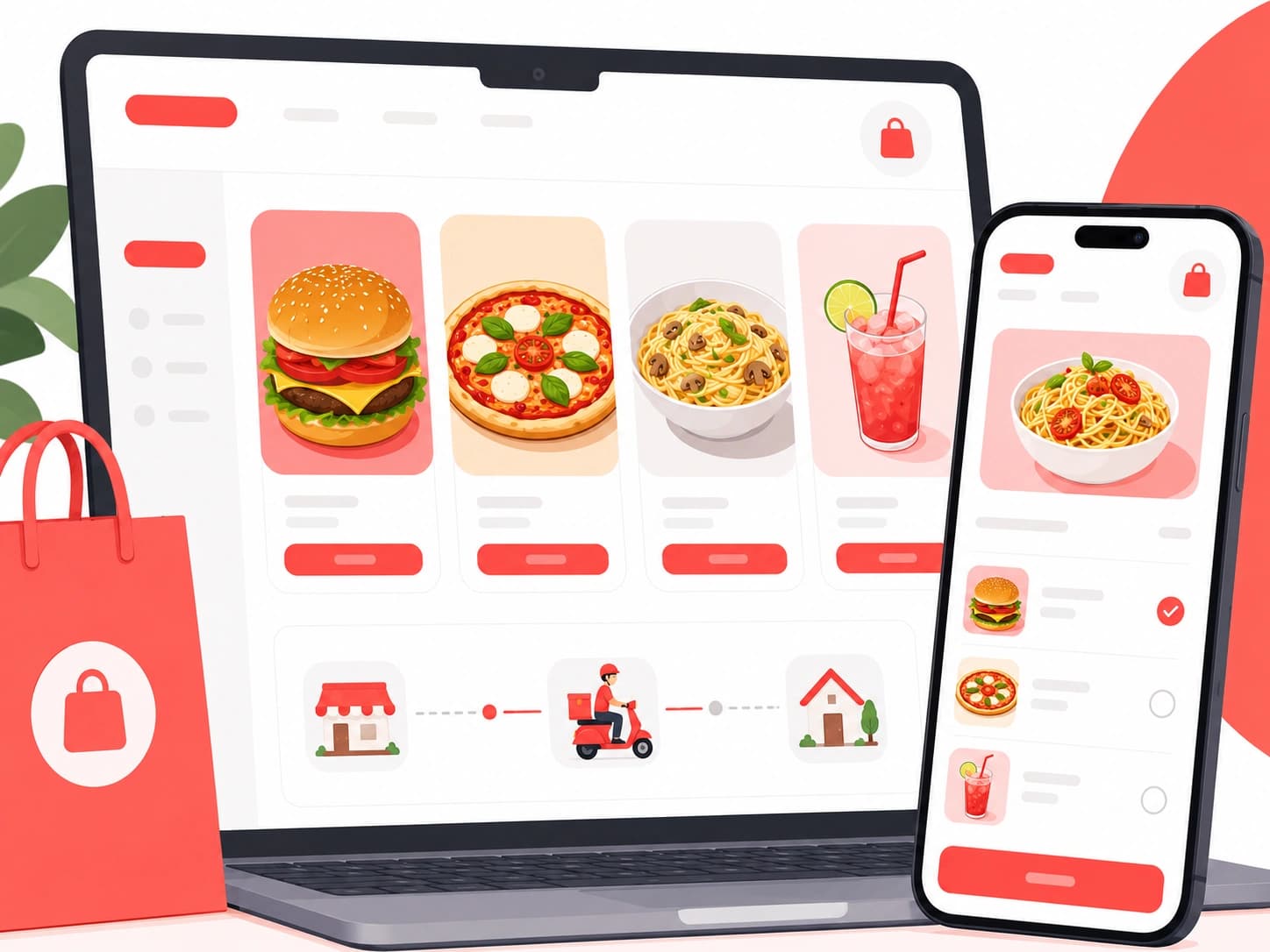
A restaurant ordering app is a custom mobile application built specifically for your restaurant. Customers download it from Google Play or the Apple App Store under your restaurant's name—not a third-party platform.
In the app, customers can browse your menu, place orders for pickup or delivery, track orders in real-time, save favorites, earn loyalty rewards, and receive push notifications about specials.
The critical difference: you own the relationship. You own the customer data. You own the repeat orders. When a customer orders through your app, you know about it. When they order through Talabat, Talabat knows about it.
- Browse your menu
- Place orders for pickup or delivery
- Track orders in real-time
- Save favorite meals
- Get loyalty rewards
- Receive push notifications about specials
The real cost of delivery platform commissions
Most restaurants don't realize how much they're actually losing to platforms when you include commissions, fees, and promotional costs.
Let's do the math for a mid-sized restaurant in Dubai doing 100 orders per day at AED 80 average order value with 25% commission.
Daily cost: 100 orders × AED 80 × 25% = AED 2,000. That's AED 60,000 per month.
But that's just the commission. When you add payment processing (2.5%), platform discounts (AED 5,000–10,000/month), and other fees, the real number is much higher.
| Cost | Amount | Reason |
|---|---|---|
| Commission (25%) | AED 60,000/month | Per-order fee to platform |
| Payment processing (2.5%) | AED 2,000/month | Platform takes a cut of payment |
| Promotional credits | AED 5,000–10,000/month | Platform discounts |
| TOTAL MONTHLY COST | AED 67,000–72,000 | Real number |
| TOTAL ANNUAL COST | AED 804,000–864,000 | What it actually costs |
That's 35% of your profit
For a restaurant making AED 200,000/month in profit, losing AED 70,000 to commissions is 35% of your entire profit margin.
Direct orders change the equation
Imagine moving 70% of your orders to your own app while keeping 30% on delivery platforms.
Same restaurant. Same 100 orders per day. But 70 come through your app. 30 come through Talabat.
Here's what happens to your costs.
| Metric | Delivery App (30 orders) | Your App (70 orders) | Total |
|---|---|---|---|
| Orders per day | 30 | 70 | 100 |
| Daily revenue (AED) | 2,400 | 5,600 | 8,000 |
| Commission (25%) | 600 | 0 | 600 |
| Payment processing (2.5%) | 60 | 140 | 200 |
| TOTAL DAILY COST | 660 | 140 | 800 |
| MONTHLY COST | 19,800 | 4,200 | 24,000 |
| SAVINGS vs all-platform | — | — | AED 36,000–48,000 |
That's AED 432K–576K per year
Enough to hire another chef, open a second location, or increase profit by 25–35%.
How to get customers to order directly
The biggest question: how do you move customers from Talabat to your app? The answer is simpler than most think.
Make it frictionless. Put QR codes on receipts. Put it in your WhatsApp menu. Put it on Instagram. Make downloading your app a 10-second action.
Offer incentive. If Talabat takes 25%, you can offer a 10% discount on direct orders and still break even on the commission difference. Customers see AED 80 on Talabat, AED 72 on your app—they'll order on your app.
Build loyalty. Every order earns points. After 10 orders, the 11th is free. Talabat doesn't offer this. Your app does.
Send push notifications. On Friday at 5:30 PM, send: 'It's dinner time. Your favorite biryani is ready—order now.' That notification brings back 15–20% of users.
- QR codes on receipts, tables, and packaging
- 10–20% discount on direct orders
- Loyalty program (free item after N orders)
- Push notifications for Friday/weekend orders
- Saved payment methods for faster checkout
What about delivery? Do you need your own drivers?
You don't need your own delivery fleet. There are smart ways to handle delivery without paying 25% commission.
Option 1: Use Talabat only for delivery (not ordering). You fulfill through your app, Talabat delivers. Their delivery-only commission is 8–12% (not 25%).
Option 2: Hire one delivery driver for AED 1,500–2,000/month. If you're doing 50+ deliveries per day, this often saves more than Talabat would take.
Option 3: Hybrid. Keep 30% of orders on Talabat (those customers who refuse your app). Move 70% to your app. Use Talabat for delivery only on that 30%.
All three options beat paying Talabat 25% on everything.
Real numbers: What restaurants actually save
Here are actual results from 20+ restaurants that built apps.
Restaurant A (Casual Diner, Dubai): Changed from 80% Talabat / 20% direct to 30% Talabat / 70% app. Went from AED 52,000/month costs to AED 18,000. Saved AED 34,000/month. ROI in 6 months.
Restaurant B (Fine Dining, Abu Dhabi): Was 100% Talabat. Moved to 40% Talabat / 60% app. Went from AED 60,000/month to AED 28,000. Saved AED 32,000/month. ROI in 5 months.
Restaurant C (Cloud Kitchen, Dubai): Was 100% Talabat + hired delivery driver. Moved to 50% Talabat / 50% app + driver. Went from AED 64,000/month to AED 21,000. Saved AED 43,000/month. ROI in 4 months.
Pattern: ROI happens in 4–6 months. After that, it's pure profit.
ROI pays for itself in 4–6 months
After that, every month you save AED 30K–50K that would have gone to platforms.
The secondary benefits (numbers don't capture these)
Saving on commissions is obvious. But there are deeper wins.
Customer data is gold. You know their order history, favorite items, delivery address, and ordering times. You can email old customers, send birthday offers, and optimize your menu based on bestsellers.
You control the experience. On Talabat, you're next to 50 competitors. In your app, customers see only you. Your design. Your story. Your brand.
You can experiment. Test new menu items on early customers. A/B test layouts. Run limited-time offers. Track impact. Restaurants that optimize through their apps increase average order value by 12–18% over a year.
You're not dependent on an algorithm. Talabat's algorithm controls visibility. Your app doesn't. Customers see you every time they open it.
How to get started (without technical headaches)
You don't need to be a developer. You don't need expensive help. Getting started is simple.
Most restaurants are live with an ordering app within 6–8 weeks from decision to Google Play launch.
Path 1: Custom App (Recommended). A branded app built specifically for your restaurant. Takes 4–8 weeks. One-time cost. You own it forever. No monthly fees.
Path 2: Platform. Some restaurants use managed platforms where the platform handles the app. Less control, more simplicity.
Both work. The difference is control vs simplicity.
- Week 1: Share your menu, colors, logo
- Weeks 2–6: App gets built
- Week 7: Google Play submission
- Week 8: Live on Google Play and Apple App Store
Frequently asked questions
Conclusion
Your restaurant is losing money to platforms every single day. Not because you're doing anything wrong—because you outsourced the customer relationship to a middleman. An ordering app fixes that. It costs one-time. It pays for itself in 4–6 months. And it gives you control over customers, pricing, and your future. The restaurants that built apps in 2024 are now saving AED 30K–50K per month. The restaurants that didn't are still losing that money. The choice is yours.
Discussion
Comments
No comments yet.
Ask a question or add what worked in your restaurant.